

Views: 0 Author: Site Editor Publish Time: 2026-08-04 Origin: Site


Buyers face a saturated market filled with exaggerated claims when upgrading vanity spaces. Distinguishing between high-utility features like high-CRI lighting or reliable defoggers and failure-prone gimmicks is difficult. You must also navigate strict electrical safety requirements for wet environments. We evaluate these units based on lighting efficacy, display utility, integration capabilities, aesthetic alignment, and critical installation realities. A proper installation requires understanding wall blocking, dedicated circuits, and moisture protection. We will break down the exact specifications you need to look for. This framework helps you avoid costly electrical mistakes and ensures the hardware matches your daily routine. You need hardware that performs reliably under heavy moisture loads. We focus on the physical constraints of bathroom environments and the structural requirements for mounting heavy electronic fixtures securely.
Lighting Quality Over Novelty: Prioritize a high Color Rendering Index (CRI 90+) and adjustable color temperatures for accurate grooming before investing in secondary ambient features like RGB lighting.
Infrastructure Dictates Capability: Integrated displays and built-in audio require specific electrical planning; hardwired solutions with proper Ingress Protection (IP) ratings are non-negotiable for safety and longevity.
Ecosystem Compatibility: A true smart mirror should seamlessly integrate with existing smart home ecosystems, potentially acting as a room-level command center, rather than relying on isolated, proprietary apps that risk becoming obsolete.
Maintenance and Lifespan: Evaluate the repairability of internal components (LED drivers, Bluetooth modules, display panels) as these will likely fail before the mirror glass itself degrades.
Establishing the primary use-case for the bathroom space determines the necessary hardware features. A high-efficiency morning routine demands bright, shadow-free illumination and rapid defogging capabilities. Users need immediate access to time, weather, and clear reflection. Conversely, a spa-like relaxation environment prioritizes warm, dimmable ambient lighting and integrated audio for background music. Identifying the primary function prevents overspending on mismatched technology. You must match the hardware specifications directly to the daily habits of the household. We see many homeowners buy feature-heavy units only to realize they never use the built-in web browser. Focus on what actually speeds up your morning or improves your evening wind-down.
Differentiating between essential upgrades and niche additions ensures long-term satisfaction. Anti-fog demister pads and high-quality task lighting represent core functionalities that improve daily use. They solve actual physical problems in wet environments. Niche additions often include social media integration or full web browsers built into the glass. These features frequently suffer from slow processors, outdated software, and poor user interfaces. Prioritize hardware that performs a few critical tasks exceptionally well. A responsive touch interface for lighting control holds more value than a sluggish smart display that struggles to load basic applications.
Balancing high-tech features with interior design requires careful selection of shapes and frames. The technology must complement the bathroom decor. Frameless designs offer a sleek, minimalist look that blends well with modern fixtures. Framed units provide traditional or industrial aesthetics, hiding thicker electronic housings. Geometric shapes like pill-shaped, round, or oversized rectangular mirrors alter the spatial perception of the room. The physical footprint of the unit must align with the vanity width and ceiling height to maintain visual proportion. An oversized unit overwhelms a small powder room, while an undersized unit looks out of place above a double vanity.
Ambient moisture, temperature fluctuations, and available wall space dictate hardware choices. Bathrooms experience rapid shifts in humidity and heat. Electronics must withstand these harsh conditions without degrading. Available wall space limits the size of the display and the placement of integrated speakers. You must evaluate the distance from the vanity to the shower or bathtub. This proximity determines the required water resistance levels. Furthermore, the existing wall structure dictates whether a heavy, feature-rich unit can be safely mounted without extensive reinforcement.
Conduct a thorough site assessment before selecting a unit:
Measure the exact distance between the vanity top and the lowest overhead light fixture to determine maximum vertical clearance.
Locate the nearest wall studs using a magnetic finder to confirm if structural blocking is required for heavy units.
Identify the current electrical supply line behind the drywall to see if a new dedicated circuit pull is necessary.
Assess the ventilation fan capacity to ensure ambient humidity clears fast enough to prevent long-term electronic degradation.
The Color Rendering Index (CRI) serves as the most critical metric for a grooming mirror. CRI measures how accurately a light source reveals the true colors of objects compared to natural sunlight. A CRI of 90 or higher is non-negotiable for makeup application and precision shaving. Lower CRI values make skin tones appear washed out or unnaturally green. Edge-lit configurations place LEDs around the perimeter, firing light inward through a diffuser. This creates a soft, ambient glow. Backlit configurations push light directly forward through frosted glass bands. Backlit designs provide superior shadow reduction for detailed facial tasks. Front-lit designs offer the highest lumen output directly onto the user's face, eliminating overhead shadows cast by standard ceiling cans.
Smooth dimming requires high-quality LED drivers. A reliable dimmable bathroom mirror often utilizes built-in capacitive touch sensors or integrates with wall-mounted TRIAC dimmers. Phase-cut dimming systems must be compatible with the mirror's internal power supply to prevent flickering or buzzing at low light levels. Tunable white light allows users to adjust the Kelvin temperature. Morning routines benefit from crisp, cool light around 5000K to 6000K, simulating daylight. Evening routines require warm light around 2700K to 3000K. Circadian rhythm lighting automates these shifts. It syncs the color temperature with the time of day to support natural sleep cycles. Modern LED arrays consume significantly less power and generate less heat than traditional incandescent vanity bulbs.
Objectively assessing the value of colored lighting requires separating ambient design from functional grooming. An RGB LED bathroom mirror serves primarily as an architectural enhancement. It provides backlighting that washes the wall with customizable colors. This feature excels in creating smart home scenes for relaxation modes or unique visual aesthetics. However, RGB lighting cannot replace high-CRI white light for daily tasks. The colored LEDs should operate independently from the primary task lighting. This separation ensures users can enjoy ambient effects without compromising visibility during grooming. When wiring these units, ensure the RGB controller retains its memory setting after a power cycle, so you do not have to reset your preferred color every time you flip the wall switch.
Lighting Configuration Comparison
Lighting Type | Primary Function | Shadow Reduction |
|---|---|---|
Edge-Lit | Ambient glow, aesthetic framing | Low |
Backlit (Frosted Band) | General grooming, balanced illumination | Medium |
Front-Lit (Direct) | Precision makeup, detailed shaving | High |
RGB Backlight | Architectural accent, mood lighting | None |
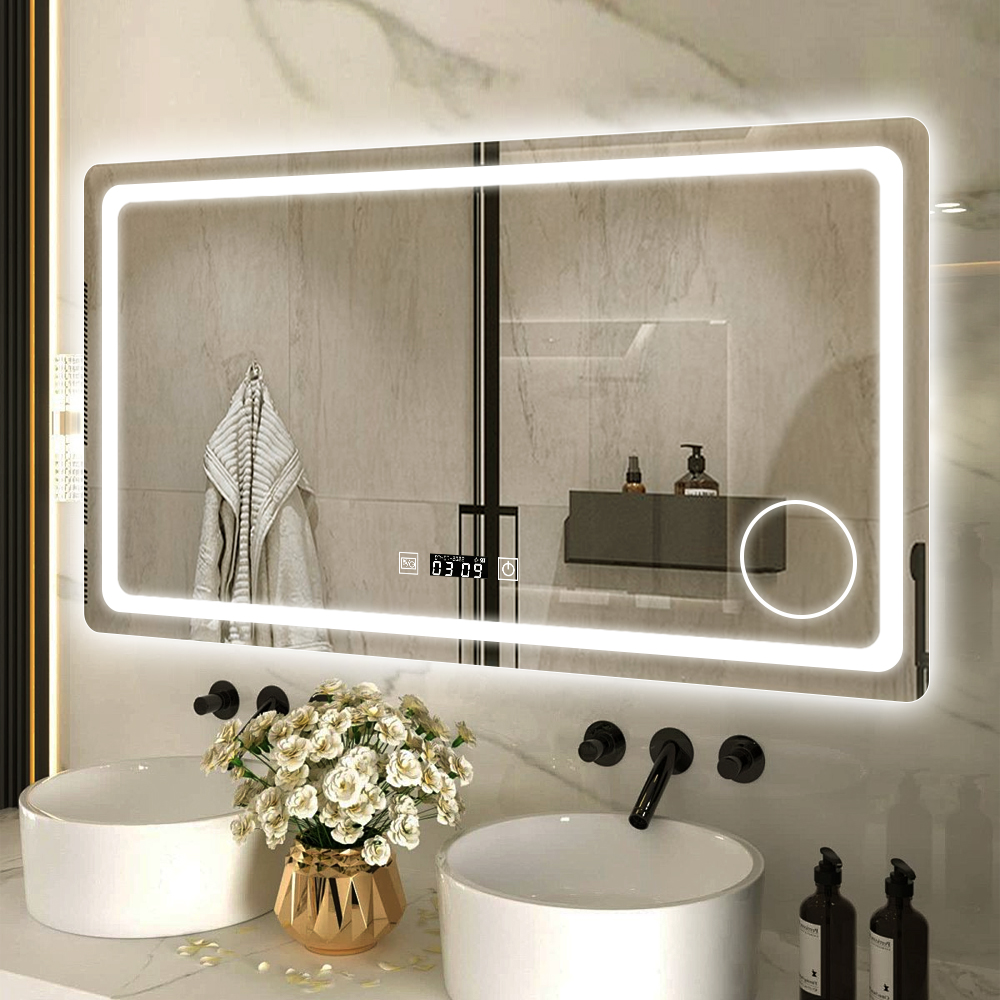
Integrated displays range from basic LED information hubs to Full HD LCD panels. Basic hubs show time, temperature, and weather icons using simple segmented LEDs. Advanced units feature full screens capable of streaming video. The mechanics of dielectric two-way glass make these screens viable. Dielectric glass allows a TV display to completely disappear into a seamless reflective surface when powered off. This vanishing effect maintains the room's aesthetic. The glass consists of multiple layers, including a highly reflective coating and a polarized filter. However, there is a trade-off. To allow light from the screen to pass through, the glass cannot be completely reflective. Users may notice a slight reduction in overall mirror brightness compared to standard silver-backed glass. The LCD panel behind the glass must also possess a high nit rating to push enough light through the dielectric layer, otherwise the screen appears washed out in a brightly lit bathroom.
Evaluating the acoustic realities of built-in speakers requires understanding bathroom environments. Tiled, echo-heavy rooms distort sound. A well-designed Bluetooth bathroom mirror uses downward-firing or rear-firing transducers to bounce sound off the wall, improving bass response. The speaker cones themselves must be constructed from moisture-resistant materials like Mylar rather than standard paper to prevent degradation from humidity. Pairing stability remains crucial. The Bluetooth module must reconnect automatically to recognized devices without manual intervention. Multi-device management allows different family members to connect seamlessly. Latency considerations matter if the user intends to watch video on the mirror display while routing audio through the built-in speakers. Audio sync issues ruin the viewing experience.
Analyzing the protocols used for voice assistant integration reveals the true utility of the unit. Wi-Fi connections allow direct integration with cloud-based assistants. Zigbee or Z-Wave protocols require a dedicated smart home hub but offer better local control. The mirror possesses the potential to act as a central command center. Users can adjust the bathroom thermostat, control overhead lights, or start the shower directly from the vanity touchscreen. Relying on third-party companion apps for core functionality introduces significant risks. If the manufacturer stops updating the app, the smart features become obsolete. Native integration with major ecosystems ensures longevity. Look for units that support Matter or Thread protocols to guarantee future-proof connectivity across different smart home platforms.
Heated demister pads prevent condensation from forming on the glass surface. These thin, electrically heated pads adhere to the back of the mirror. When activated, they gently warm the glass above the dew point of the room. Energy consumption remains relatively low, typically drawing between 20 to 50 watts depending on the size. Auto-shutoff safety features are critical. They prevent the heating element from running continuously if left unattended, reducing fire risks and energy waste. The actual surface area covered by the heating element rarely spans the entire glass. It usually targets a central viewing rectangle directly in front of the user. When wiring a bathroom, contractors often put the defogger on a separate relay switch rather than tying it directly to the exhaust fan. This allows the user to run the defogger silently without the noise of the overhead ventilation.
Detail work like applying eyeliner or shaving requires closer inspection. An integrated magnifying bathroom mirror features an inset zone, typically offering 3x to 5x magnification. This eliminates the need for separate, cluttered countertop mirrors. However, inset zones have a fixed focal distance. Users must lean in to achieve a clear image. Separate articulated mirrors allow users to pull the glass toward their face. For an integrated zone to function properly, it requires dedicated LED ring lighting around the magnified circle. Without direct illumination, the magnified image appears dark and unusable due to shadows cast by the user's head. The transition line between the standard flat glass and the concave magnifying section must be seamlessly ground to prevent visual distortion at the edges.
Capacitive touch buttons etched into the glass surface provide a sleek, modern interface. They control lighting, defoggers, and power. However, touch controls can become unresponsive when hands or the glass are wet. Infrared motion sensors offer touchless control. Users wave a hand under the frame to toggle lights, keeping the glass free of fingerprints. Voice activation provides the ultimate hands-free experience, ideal for adjusting settings mid-routine. The reliability of these interfaces dictates user frustration levels. Redundant control options, such as combining voice commands with physical touch buttons, offer the most robust user experience. Hardwiring the primary power to a standard wall switch while leaving the granular controls on the glass surface provides the best of both worlds.
The difference between plug-in models and hardwired installations dictates the complexity of the project. Plug-in models require an existing, visible outlet, which often detracts from the clean aesthetic. Hardwired installations conceal all wiring behind the unit, connecting directly to the home's electrical grid. A true Smart Bathroom Mirror heavily relies on stable, safe power delivery. Ground Fault Circuit Interrupter (GFCI) protection is mandatory for any electrical fixture near water sources. High-draw models featuring large displays, powerful heaters, and extensive LED arrays may require a dedicated circuit to prevent tripping breakers when other appliances run simultaneously. Pulling a new 15-amp or 20-amp dedicated line from the main breaker panel ensures the mirror operates without voltage drops, which can cause LED flickering or display resets.
Ingress Protection ratings define the hardware's resistance to dust and moisture. Understanding these ratings ensures safety and compliance with local building codes. Bathrooms are divided into specific electrical zones based on proximity to water sources. Fixtures installed in vanity areas must meet strict minimum requirements to prevent electrical shorts and corrosion. Installing non-compliant fixtures impacts homeowner insurance policies. If an electrical fire results from an improperly rated device, the claim may be denied. Always verify the IP rating stamped on the manufacturer's specification sheet before installation. Do not rely solely on marketing materials that claim a product is waterproof without providing the exact IP certification numbers.
Bathroom Electrical Zones and IP Requirements
Bathroom Zone | Location Description | Minimum IP Rating |
|---|---|---|
Zone 0 | Inside the bath or shower space directly exposed to water. | IP67 (Immersion protected) |
Zone 1 | The area directly above the bath or shower up to 2.25 meters. | IP65 (Water jet protected) |
Zone 2 | The area extending 0.6 meters outside the perimeter of the bath/shower. | IP44 (Splash protected) |
Outside Zones | General vanity areas away from direct water sources. | IP44 (Recommended for ambient humidity) |
The significant weight difference between standard glass and technology-heavy units requires robust mounting strategies. Standard mirrors often hang on simple wire or basic drywall anchors. Smart units contain metal chassis, thick dielectric glass, and heavy power supplies. They require structural blocking behind the drywall. Contractors must cut the drywall, install horizontal 2x4 blocking between the vertical studs, patch the wall, and paint before mounting the fixture. Heavy-duty aluminum French cleats distribute the weight evenly across this blocking. Surface-mount installations protrude from the wall, exposing the finished edges of the chassis. Recessed installations sit flush with the drywall, creating a custom, built-in look but requiring extensive framing modifications and precise drywall finishing to accommodate the depth of the electronic housing.
Breaking down the cost drivers reveals where the investment goes. High-quality dielectric glass, advanced display panels, and reliable LED drivers account for the majority of the price. The reality of integrated technology is that electronic components have a shorter lifespan than the mirror glass itself. A display panel or Bluetooth module may fail within five to seven years, while the glass remains pristine. Energy savings from efficient LEDs and auto-shutoff features offset some operational costs, but they rarely recoup the initial premium paid for the technology. Buyers must accept that they are purchasing an electronic appliance, not just a static fixture. Planning for future component replacement is part of the ownership cycle.
Evaluating manufacturer warranties protects the investment. Look for warranties that separate the glass coverage from the electronic component coverage. The importance of modular designs cannot be overstated. High-quality units allow technicians to replace failed LED strips, blown power supplies, or malfunctioning touch sensors without discarding the entire unit. Sealed, unrepairable units force a complete replacement if a single component fails. Prioritize manufacturers that sell replacement parts directly to consumers and provide clear schematics for accessing the internal chassis.
Check these warranty details before buying:
Duration of coverage for the LED driver and power supply.
Availability of replacement capacitive touch sensors.
Policy on silvering degradation or edge desilvering.
Shipping costs for heavy replacement parts.
Measure your exact vanity width and available vertical wall space, accounting for clearance around faucets and light fixtures.
Consult with a licensed electrician to verify if your current bathroom circuits can handle the additional load and to plan the hardwiring route.
Confirm the exact IP rating of the unit and ensure it complies with the specific electrical zone where it will be mounted.
Finalize your smart home ecosystem preference to ensure native compatibility without relying on proprietary apps.
A: Yes. While some models use standard plugs, most high-end units require hardwiring directly into the home's electrical system. This conceals the wires and provides stable power. The circuit must have Ground Fault Circuit Interrupter (GFCI) protection to meet safety codes for wet environments.
A: The anti-fog feature uses a thin, electrically heated demister pad attached to the back of the glass. When turned on, it gently warms the surface above the room's dew point. This prevents steam from condensing into water droplets on the heated section of the glass.
A: No. Units with integrated displays use dielectric two-way glass. When the screen behind the glass is powered off, the surface reflects light just like a standard mirror. This creates a vanishing effect, completely hiding the display technology until it is turned back on.
A: This depends entirely on the manufacturer's design. High-quality models feature a modular chassis that allows you to unscrew the back panel and replace individual LED strips or drivers. Cheaper models are often sealed shut with adhesive, requiring full unit replacement if the lights fail.
A: They are safe only if they carry the proper Ingress Protection (IP) rating. For vanity areas, the unit must be rated at least IP44, which protects against splashing water and high humidity. The electronic housings must be properly sealed to prevent internal corrosion.
A: For makeup application and grooming, a crisp, daylight-simulating temperature between 5000K and 6000K is ideal. For evening relaxation or ambient lighting, a warmer temperature between 2700K and 3000K is preferred. Tunable mirrors allow you to switch between these ranges.


