

Views: 0 Author: Site Editor Publish Time: 2026-07-09 Origin: Site


Upgrading a modern vanity setup demands more than simply hanging a reflective glass panel. Improper lighting often distorts natural skin tones. Poorly scaled frames ruin the spatial harmony of your entire room. Choosing the wrong fixture carries real consequences. You might suffer through inadequate task lighting every morning. Incorrect electrical specifications invite serious safety risks inside high-humidity wet zones. Mistakes here also lead to frustrating and highly avoidable installation rework.
We provide a pragmatic, spec-driven framework below. You will discover how to match structural dimensions properly. We explore essential luminaire performance metrics for daily grooming. You will also learn crucial installation realities. This guide ensures your next bathroom upgrade delivers both flawless function and refined aesthetics. You will understand exactly which features matter most for daily use.
Achieving visual balance requires precise measurements. Standard design guidelines dictate a specific width equation for wall-mounted fixtures. The fixture should be exactly as wide as the cabinet below it. Alternatively, it can be one to two inches narrower. You must avoid extending the frame past the countertop edges. Overhanging glass creates a top-heavy, unbalanced aesthetic. It also draws unwanted attention to minor asymmetrical room details.
Different sink layouts require entirely different scaling strategies. Single and double layouts demand tailored approaches:
Vertical placement matters just as much as horizontal width. The center of the reflective surface should sit exactly at the primary user's eye level. This usually falls roughly five to five and a half feet from the floor. Always leave a minimum four-inch gap between the bottom edge and the backsplash. This crucial clearance prevents continuous water splashing from damaging the lower frame. It also stops the wall area from looking cluttered.
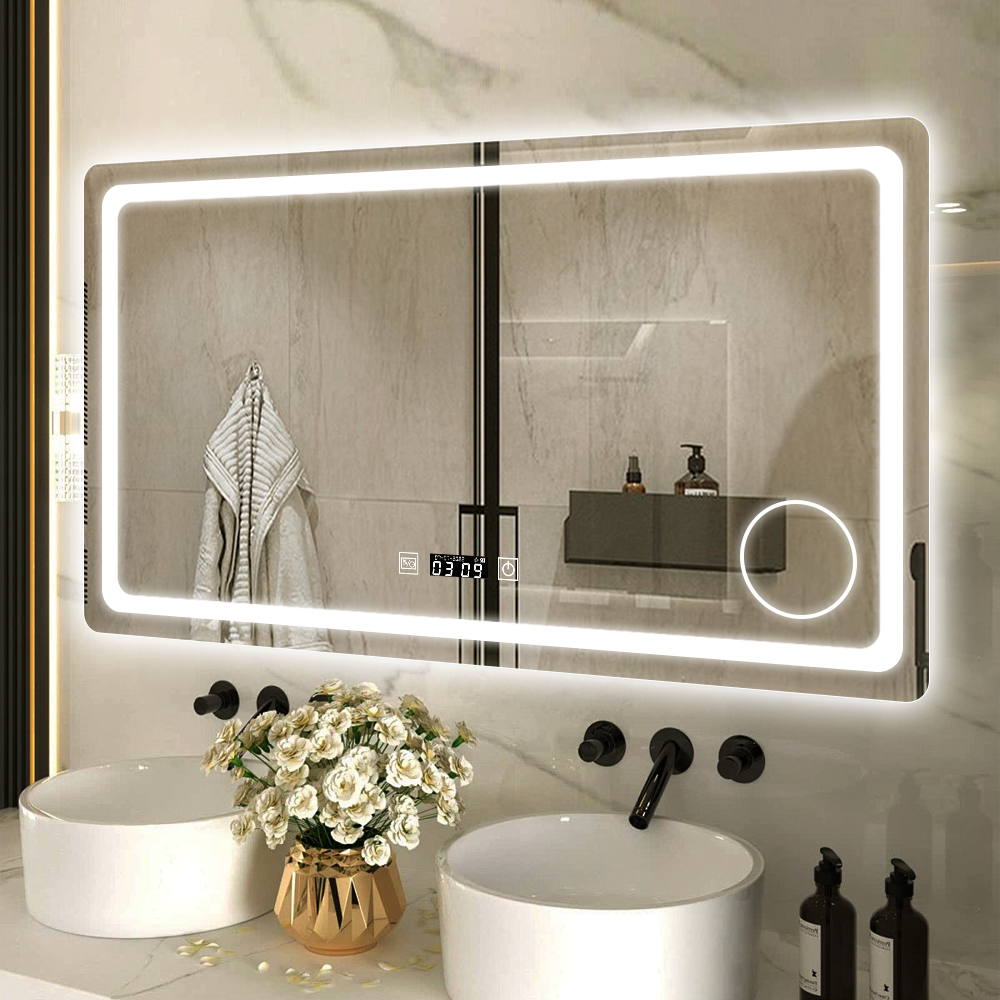
Evaluating luminaire performance separates premium fixtures from cheap alternatives. You must look beyond simple wattage. Grooming requires precision lighting. Precision requires specific technical benchmarks.
Color Rendering Index (CRI) represents a non-negotiable metric. CRI measures how accurately a light source reveals true object colors compared to natural sunlight. Cheap LEDs usually fall below 80 CRI. They create a severe "washed-out" effect on human skin. You will struggle to apply makeup accurately under low CRI conditions. Always demand a CRI of 90 or higher. High CRI ensures natural skin tones translate perfectly from the bathroom into the outside world.
Color temperature dictates the actual hue of the emitted light. It is measured in Kelvins (K). Selecting the wrong Kelvin range ruins the functionality of the space. When selecting a high-quality vanity mirror with lights, adjustable temperature settings offer the most versatility.
| Color Temperature Range | Light Appearance | Best Application |
|---|---|---|
| Warm White (2700K - 3000K) | Soft, yellowish glow | Relaxing baths, late-night ambiance. Poor for detail work. |
| Neutral / Daylight (3500K - 4000K) | Crisp, pure white | Optimal for task lighting. Mimics midday natural sunlight. |
| Cool White (5000K+) | Harsh, bluish tint | Clinical settings. Aggressively highlights minor skin flaws. |
Lumen output measures total brightness. Many buyers confuse ambient brightness for task brightness. Ambient fixtures output around 300 to 500 lumens. This low level proves completely insufficient for shaving or makeup routines. True task-lighting fixtures should deliver 700 to over 1,000 lumens per meter of integrated LED strip. Check the manufacturer specifications carefully. Insufficient lumens will force you to rely heavily on overhead ceiling fixtures.
The direction of the light completely alters its utility. Manufacturers utilize three primary directional styles. Each style serves a very specific daily routine.
Front-lit designs point the diodes directly at the user. The beams shine outward through frosted glass borders. This forward-facing design provides exceptional primary task lighting. It actively eliminates deep facial shadows caused by overhead ceiling cans. If flawless makeup application or precision shaving represents your main priority, a front-lit Led Bathroom Mirror stands as the ultimate choice.
Backlit designs hide the diodes behind the primary glass panel. The beams wash directly onto the wall behind the frame. This creates a beautiful, glowing halo effect around the edges. It looks incredibly luxurious. It highlights textured wall tiles beautifully. However, backlit units carry a significant functional risk. They primarily provide mood lighting. You will almost certainly require supplementary overhead lighting to handle detailed grooming tasks properly.
Edge-lit designs mount the diodes on the outer side frame. The diodes point either inward across the glass or outward into the room. This approach offers a compromise between front and backlit styles. It provides moderate daily utility. It allows for extremely sleek, thin frame profiles. Edge-lit units work well in small powder rooms requiring a modern aesthetic.
Here is a quick reference chart for illumination styles:
| Illumination Style | Primary Function | Shadow Reduction | Aesthetic Impact |
|---|---|---|---|
| Front-Lit | Precision grooming | High | Functional, modern |
| Backlit | Ambient mood lighting | Low | Luxurious, dramatic |
| Edge-Lit | General illumination | Medium | Sleek, minimalist |
Modern fixtures pack numerous electronic features. Some actively solve daily problems. Others simply inflate the final price tag. Evaluating return on investment (ROI) prevents wasted budget allocation.
Anti-fog defogger pads deliver an incredibly high ROI. They use a very thin built-in heating element. This element keeps the central glass perfectly clear during steamy showers. You no longer need to wipe the glass down constantly. Wiping leaves annoying streaks. A defogger actively removes a daily friction point. We highly recommend prioritizing this specific feature.
Dimmability and memory functions also provide excellent utility. You likely do not want 1,000 lumens blasting your eyes during a 2:00 AM bathroom trip. Dimmability solves this. A built-in memory sensor remembers your last brightness setting automatically. You avoid readjusting the levels every single morning. This combination adds significant, noticeable convenience to your daily routine.
Integrated clocks, internal magnifiers, and Bluetooth speakers usually offer low to medium ROI. They sound highly appealing on paper. Real-world performance often disappoints. Built-in speakers frequently lack audio depth. The sound can become tinny over time. Fixed magnifiers present another ergonomic issue. A permanently placed magnifier circle might not align perfectly with the height of every household member. Evaluate your habits honestly. Determine if these extras add genuine value to your life.
Bringing electricity into a high-humidity zone requires strict adherence to safety protocols. You must decide early between hardwired and plug-in power solutions.
Hardwired models offer the cleanest visual aesthetic. They hide all electrical cords entirely behind the frame. You control them using a standard wall switch or an integrated touch panel. However, hardwiring requires professional electrical installation. You must pull conduit directly behind the planned mounting location. This introduces a hidden project cost. You should factor electrician labor into your overall budget planning.
Plug-in models allow for easier DIY installation. You simply mount the hardware and connect the plug to an existing wall outlet. Unfortunately, this method usually leaves power cords visible. The outlet must sit directly behind or immediately adjacent to the frame to look acceptable.
Bathrooms function as high-humidity wet zones. Moisture ingress ruins unprotected electronics rapidly. You must ensure the chosen unit carries a minimum rating of IP44. The IP44 certification guarantees protection against solid particles larger than 1mm. More importantly, it certifies robust protection against water splashes from all directions. Never install unrated electronics near a sink or shower basin.
Load-bearing constraints demand careful attention. High-quality units containing built-in transformers, thick glass, and copper-free backings weigh significantly more than standard frames. Basic plastic drywall anchors often prove completely insufficient. Installation hardware must hit solid wooden wall studs. If stud placement does not align with your center line, you must utilize heavy-duty commercial-grade mounting cleats.
Selecting the ideal fixture requires balancing physical constraints against daily functional needs. Follow a strict shortlisting logic. Base your first decision on physical spatial limits. Calculate your vanity width carefully and locate your wall studs. Base your second decision on lighting requirements. Choose between front-lit or backlit styles while demanding a CRI over 90. Finally, allocate your remaining budget toward premium utility features like heated defogger pads.
Take immediate action using these next steps:
A: No. Even the brightest vanity mirror is designed strictly for directional task lighting or ambient glow. It cannot illuminate an entire room safely. You should always pair it with overhead lighting like recessed ceiling cans or a central fixture for general room illumination.
A: Commercial-grade LEDs typically last over 50,000 hours. This equals roughly 10 to 15 years of average daily use. The actual light diodes rarely burn out. The internal power driver is usually the first component to fail. Always look for brands offering replaceable drivers.
A: No. Most integrated heating pads consume extremely low wattage. They draw power similar to a single standard lightbulb. They are intentionally designed to only run when the main lights are powered on or when a specific defogger button is manually engaged.


