


Views: 0 Author: Site Editor Publish Time: 2026-10-26 Origin: Site


You spend twenty minutes carefully blending your foundation indoors. You step outside. The colors clash completely. The mirror is rarely the problem. The hidden culprit is your lighting setup. This brings us to a critical engineering metric: the Color Rendering Index.
This scientific standard dictates how true-to-life colors appear under artificial illumination. As a lighting specialist, I constantly see homeowners and designers overlook this detail. In this guide, I will break down exactly how this index impacts your daily routines. We will explore why it remains the most critical specification to check before purchasing a fixture. Choosing the right setup ensures flawless grooming and eliminates visual guesswork.
The Color Rendering Index measures how accurately a light source reveals true colors compared to natural sunlight. It operates on a strict scale of 0 to 100.
For detailed tasks like applying makeup or clinical skincare, a rating of 90 or above is the minimum recommended baseline.
This metric differs fundamentally from Color Temperature. Temperature determines if a light looks warm or cool. Rendering dictates if the underlying pigments are scientifically accurate.
Investing in premium fixtures prevents common visual errors. These include mismatched foundation and distorted outfit color pairing.
In lighting design, the Color Rendering Index is a quantitative metric. We use it to measure the ability of an artificial light source to faithfully reveal the colors of various objects. Evaluated on a scale from 0 to 100, higher numbers indicate vastly superior color fidelity. Natural sunlight contains a complete spectrum of visible light. Therefore, it serves as the perfect baseline with a maximum score of 100.
When you stand in front of a vanity, the light hits your face and reflects back into your eyes. If that source is missing essential wavelengths, like deep reds or subtle blues, those specific colors simply cannot reflect back to you. As a result, your perception of your skin tone becomes skewed. Artificial lights constantly strive to mimic the perfection of daylight. This index helps engineers quantify exactly how close they get.
Understanding this scale is essential for evaluating any fixture. By familiarizing yourself with these ranges, you can easily avoid purchasing low-quality units for your bathroom.
Range | Rendering Quality | Visual Effect and Typical Applications |
|---|---|---|
Below 70 | Poor | Colors appear heavily washed out or possess a greenish tint. Typically used in streetlights and industrial warehouses. |
70 to 80 | Acceptable | Basic color distinction is possible. Subtle hues are lost. Suitable for garages and basic utility spaces. |
80 to 90 | Good | Satisfactory for general ambient lighting in living rooms. Colors look relatively normal but lack true biological vibrancy. |
90 to 100 | Excellent | Colors are vibrant and true-to-life. Essential for high-end personal grooming and photography studios. |
Applying makeup is fundamentally an exercise in precise color matching. Human skin contains complex undertones ranging from cool pinks to warm olives. Unfortunately, low-quality lights inherently mute natural red and pink tones due to their incomplete spectral distribution. Imagine spending time carefully blending foundation indoors, only to catch a glimpse of yourself in the car looking inexplicably orange. This optical illusion causes individuals to over-apply blush or select mismatched foundation shades. High-fidelity lighting ensures the pigments you see indoors match what you project outdoors.
Skincare requires distinct visual clarity. Accurate lighting is absolutely necessary to spot subtle skin imperfections or dry patches during your morning routine. For daily shaving, inadequate lighting creates artificial shadows. It fails to highlight the contrast between facial hair and skin. This leads to missed patches and accidental nicks. In clinical skincare routines, accurately assessing skin redness is nearly impossible without a light source that renders colors authentically.
The phenomenon of colors appearing different under various light sources is scientifically known as metamerism. This causes the classic wardrobe dilemma of struggling to distinguish between navy blue and black. Low-quality bulbs fail to output the necessary wavelengths to differentiate dark fabrics. Upgrading your dressing area eliminates this confusion entirely. It ensures your coordinated outfit retains its intended color harmony in natural environments.
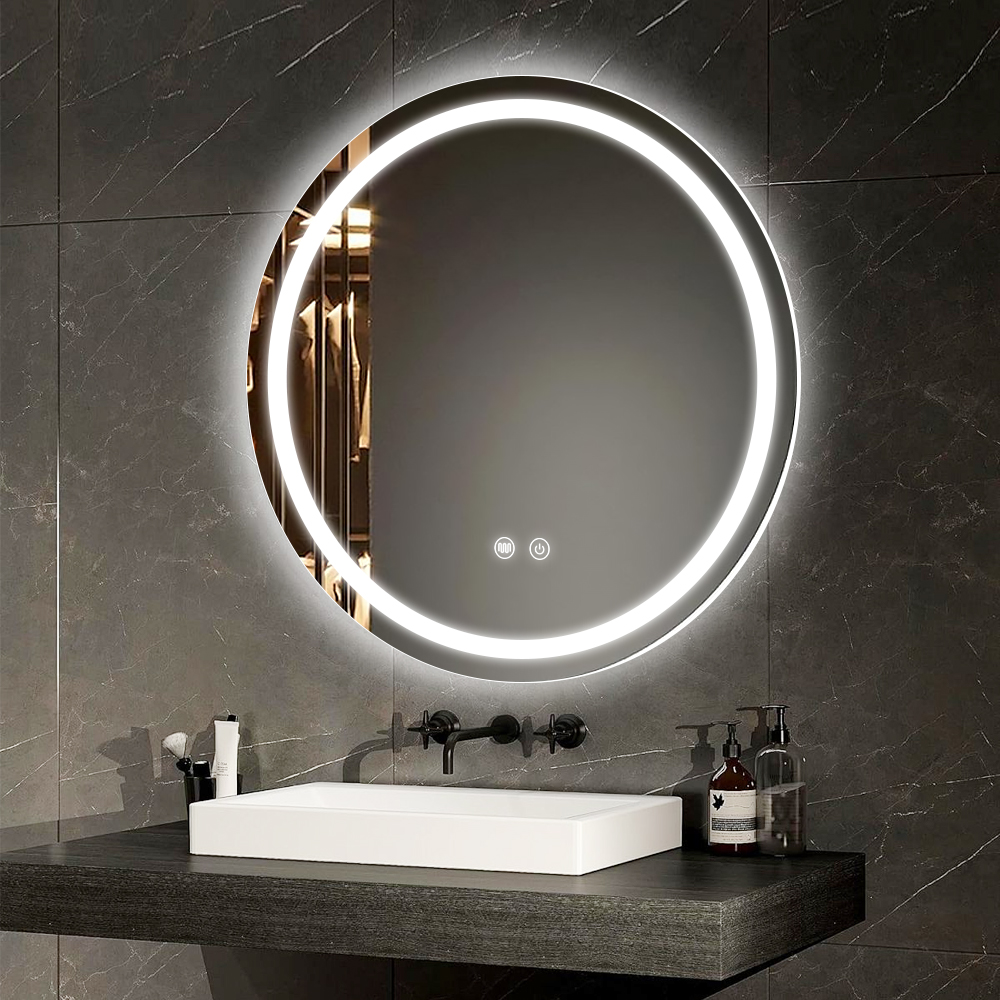
Standard bathroom lighting typically hovers around an index score of 80. While sufficient for navigating a hallway, it is highly inadequate for facial illumination. Under standard lighting, the human face takes on a severely washed out appearance. Your skin may look dull or completely lack its healthy glow. This occurs because standard diodes often feature a harsh spike in the blue spectrum. They suffer a severe deficiency in warm reds. This creates an unflattering reflection that emphasizes dark circles and makes you look tired.
Upgrading to a premium 90 CRI mirror provides an immediate visual improvement. At this premium tier, the light source emits a beautifully balanced spectrum. The reflection transforms instantly. Skin looks healthy, vibrant, and natural. The contrast between your eyes, lips, and complexion becomes sharp and defined. Lighting professionals universally recommend this standard as the absolute minimum for cosmetic purposes.
To truly understand lighting quality, engineers look beyond the basic average score. We examine the advanced R9 value. Standard testing is calculated by averaging the rendering of eight basic pastel colors, designated as R1 through R8. However, human skin tones and makeup pigments rely heavily on saturated red. This is designated as R9 on the extended scale. A bulb can technically achieve an acceptable average score by performing well on pastels while completely failing to emit red light. A true premium fixture features a high R9 value to accurately reflect biological warmth.
Correlated Color Temperature is another vital specification. It is measured in degrees Kelvin. While rendering metrics measure color accuracy, temperature dictates the overall mood of the light emitted by the bulb itself. Lower numbers like 2700K to 3000K produce a warm, yellowish glow reminiscent of incandescent bulbs. In contrast, higher numbers like 6000K to 6500K produce a stark, bluish-white light commonly found in hospitals.
Consumers frequently confuse temperature with color accuracy. A fixture can easily be labeled as Daylight at 5000K but still possess a terrible rendering score of 70. In this scenario, the light looks stark white, but your reflection appears ghostly. The fixture lacks the required spectrum to render your skin accurately. Conversely, a very warm 2700K light with a perfect score of 100 renders colors accurately, but everything is bathed in an intense yellow hue. This is equally unhelpful for makeup application. You need both specifications to be correct. The industry consensus for vanities is a neutral temperature between 4000K and 5000K paired with premium color accuracy.
A common pain point in interior design is that two LED lights rated identically at 85 can make your skin look noticeably different. This discrepancy stems directly from the limitations of the standard calculation. Because the basic metric is an average of only eight pastel colors, manufacturers can manipulate the system. Cheap diodes might spike heavily in blue and green light to artificially inflate their average score. Meanwhile, they completely lack critical red wavelengths. This uneven spectral power distribution results in a light that passes basic testing but fails in real-world applications.
Recent market data shows a massive shift toward human-centric lighting across both residential and commercial sectors. Architects and engineers are no longer solely focused on energy efficiency and raw brightness. Instead, the modern market demands advanced visual comfort to boost physiological well-being. Because of the limitations of older metrics, professionals are increasingly adopting TM-30. This comprehensive standard measures 99 distinct color samples instead of just eight. This industry-wide evolution explains why premium fixtures are now engineered to satisfy these stricter professional standards. They guarantee a visibly superior reflection.
The bathroom vanity is the most heavily utilized location for daily personal grooming. Because this intimate space is used for shaving and cosmetic application, accurate skin tone reflection is non-negotiable. Installing superior mirror lighting here prevents daily compounding errors in personal presentation. It turns a simple bathroom into a professional-grade preparation studio.
In spaces dedicated to wardrobe selection, distinguishing between subtle fabric textures is essential. High-fidelity illumination ensures that rich leathers and dark fabrics are rendered exactly as they will appear under natural sunlight. This facilitates accurate styling and prevents embarrassing color clashes once you leave the house.
In commercial environments like salons, makeup studios, and dermatology clinics, lighting directly impacts service quality. Professionals simply cannot afford to use cheap fixtures. Hair colorists rely on accurate lighting to judge dye shades. Makeup artists need it to match foundation perfectly. Dermatologists require it to diagnose skin conditions without visual interference.
When evaluating options, always look for the fidelity rating explicitly stated on the packaging. Shopping for lighting requires careful attention to detail. If a manufacturer does not proudly list this number, empirical data suggests it is highly likely to be below 80. For any application involving human reflection, strictly demand a rating of 90 or higher. This ensures your investment is truly worthwhile.
Your lighting needs naturally change throughout the day. Bright, daylight-balanced light is fantastic for morning makeup routines. A dimmer, warmer glow is far better for relaxing evening baths. The most versatile fixtures offer adjustable color temperatures. They seamlessly switch from a warm 3000K to a crisp 6000K alongside smooth dimming capabilities. Crucially, top-tier models maintain their high color accuracy across all brightness levels.
The quality of the emitted light is only half the equation. The physical medium reflecting it is equally important. When I review project specs, I look for specific baselines. For instance, a premium LED Mirror Light must integrate high-density diodes directly with a 5-millimeter copper-free silver glass. This powerful combination prevents the green tint common in standard glass and resists edge corrosion over time. Furthermore, built-in defoggers and IP44 waterproof ratings are non-negotiable for damp bathroom environments. These features provide the ultimate, distortion-free visual experience required for precision daily routines.
Ultimately, a mirror is only as effective as the light illuminating it. Without a high color rendering capacity, even the most expensive, distortion-free glass provides an inaccurate reflection of reality. By understanding the science behind color fidelity and temperature, you can make informed purchasing decisions. These choices fundamentally improve your daily grooming routines. Stop settling for inadequate bathroom lighting that washes you out and distorts your true appearance. Whether you are outfitting a luxury hotel or upgrading your master bath, selecting the right fixture is paramount. Explore the professional-grade options at Kaitze to find high-fidelity, copper-free mirrors engineered for perfect color accuracy and lasting durability. Upgrade your space today and see yourself in the best possible light.
While an 80 rating is perfectly acceptable for general room lighting and navigating hallways, it is highly discouraged for bathroom mirrors. It fundamentally lacks the critical red tones necessary to accurately reflect human skin and blood flow. Choosing a fixture rated at 90 or above is the scientifically superior and universally recommended choice for proper facial grooming.
A color temperature between 4000K and 5000K is the absolute best combination for makeup application. This range closely mimics bright, natural morning daylight. When paired with a high fidelity rating, this specific balance ensures the light is neither too yellow nor too blue. It provides a perfectly neutral canvas for accurate color judgment.
No, these are two entirely different measurements. Color rendering measures color accuracy, while lumens measure actual brightness. You can easily have a blindingly bright light with terrible color accuracy. This results in a bright but sickly reflection. Conversely, you can have a dim light with perfect accuracy. You need adequate lumens alongside high fidelity for the absolute best results.
Cheap fixtures often utilize low-quality diodes with a rendering score well under 80 and a remarkably poor R9 red value. Because they physically cannot emit the warm, natural red wavelengths naturally found in human skin, the reflected light is dominated by harsh blues and greens. This imbalance leaves your complexion looking washed out, pale, or completely sickly.
Just like human skin, clothing dyes require a full spectrum of light to display their true hues. Low-quality bulbs fail to render deep, saturated colors accurately. This causes navy blue to look black or subtle red patterns to appear muddy. High-fidelity illumination ensures the outfit you coordinate indoors looks exactly the same when you step out into natural sunlight.
If your current mirror uses replaceable bulbs, you can simply swap them out for high-fidelity LED bulbs rated at 90 or above. However, if you have an integrated backlit or edge-lit fixture with built-in diodes, the entire unit must be replaced. Upgrading to a modern, copper-free unit with premium integrated diodes is the most effective way to guarantee professional-grade illumination.


